

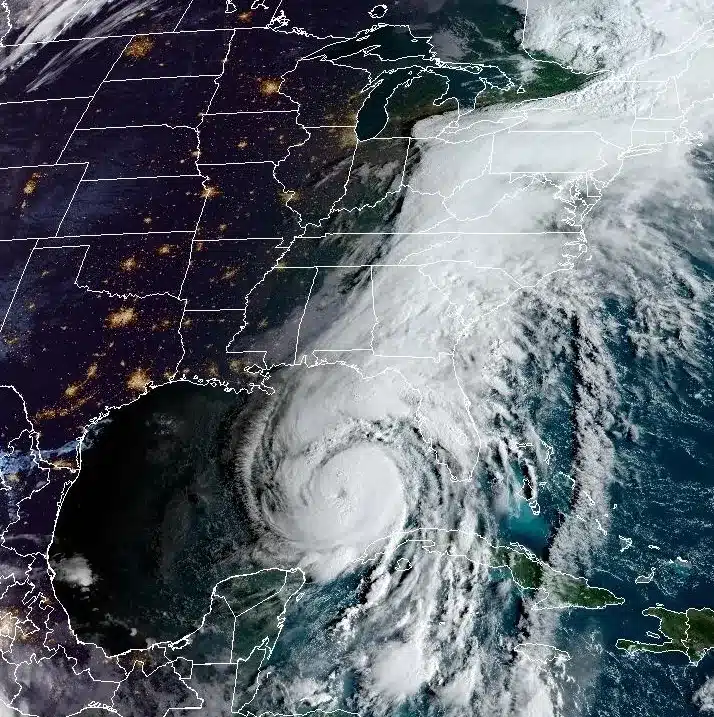
Somewhere between 70 and 90 percent of the high quality crucibles used to melt the polysilicon behind modern chips are made from quartz dug out of one relatively small mining district in western North Carolina, and in late September 2024 (and then later again in early January 2025), more than two feet of rain fell on it. Both companies that mine and process that quartz, Sibelco and The Quartz Corp, shut down ahead of the storm, and for the better part of two weeks nobody outside those companies could say when (or whether) either would come back. In the elongated meantime, no fab went idle, no chip price chart broke, and the whole thing stayed a headline for about a month, which is precisely why it is worth reading carefully.
The focus of this piece isn’t the hurricane itself, or whether the chip industry got lucky, albeit it very much did. It’s about what happens mechanically when a single point of failure sits several tiers below the vendors you actually talk to, how much of the exposure was knowable ahead of time versus how much was simply the weather, and just how flimsy even a well supported and well defended industry can be.
Three failures waiting behind one storm
A dependency four tiers down
High quality quartz, after treatment, becomes a crucible (a component that can endure the incredibly high temperatures of molten silicon); a crucible holds molten polysilicon, polysilicon becomes ingots and wafers, and wafers become the chips that a buyer finally sees on a purchase order. At no point along that chain does anyone upstream of the quartz appear on a supplier list, which means a procurement team at a company that buys finished chips would have had no field in any system labeled “Spruce Pine.” The risk was real the entire time, it just wasn’t anywhere anyone was looking.
Two suppliers, one flood
On paper the district had two operators, and two operators looks like diversification (albeit very loosely, and confined to a single region) until both of them shut down on the same day for the same reason. They shared a town, a road network, a power grid and a water supply, and when Helene knocked all of that out, the second source went down with the first. The Quartz Corp said restarting operations was a second order of priority behind the community’s recovery, and that it was too early to say when it would resume, which was a perfectly human response and a useless one for anybody downstream trying to plan.
Furthermore, any repair to their crucible-making infrastructure depended directly on the town’s infrastructure getting fixed first. Before they could repair anything on the supply chain side, those firms had to wait for the “ever expedient” local government to fix the roads, for example. In this case it took only weeks; in other parts of the world it might take months, or sadly enough, years.
The buffer that did all the work
What actually kept the shock from reaching fabs was inventory. Stockpiled crucibles and reserves were reported to cover roughly a month or more, and TSMC and Samsung both said they were well positioned to weather any disruption. Sibelco announced on October 10 that production and customer shipments had restarted and were ramping toward full capacity, so the clock never ran out. But a buffer only buys time, and the interesting question is what a company with no buffer and no visibility would have done with a restart date that was two weeks later, or two months.
“The risk was real the entire time, it just wasn’t anywhere anyone was looking.”
Prevention: mapping the dependency before the storm, not after it
The firms that watched Helene with mild interest instead of alarm were mostly the ones that already knew where their critical inputs came from, which tiers hid single sources, and how many weeks of cover they were really holding (as opposed to how many they assumed). They also treated “two suppliers” as a claim to verify, not a box to tick, by asking whether the two shared a region, a river or a road, as they did in this case. This is directly where ScopeMatch steps in as a potential solution.
How ScopeMatch maps to each failure point
Six places where a company’s own records decide how exposed it actually is.
Vendor risk ratings & dashboard rollups
Every tracked vendor carries a location and a risk rating, and rolling that up across a vendor base turns “how many of our suppliers sit in one county” into a visible number instead of a surprise. If your first tier is two different companies and both turn out to operate in the same flood zone, the rollup shows it before the forecast does. Locations you have flagged as unsafe can be filtered on your own, even if nobody has done it system wide.
Workflow-based qualification
A backup source moves through a defined pipeline of stages, checklists and document requirements, instead of a cold start after the first supplier has gone quiet. Invitation links let a new vendor begin submitting qualification documents the same day you identify them, in a format built around your own requirements, which is how a third source in a different region stops being a someday project.
Document tracking with expiry alerts
Certifications, quality documents and compliance paperwork live on the vendor record, with expiry alerts attached. A fast pivot to an alternate supplier shouldn’t also mean discovering in week two that their paperwork lapsed in March.
Incidents with resolution records
A closure, a missed shipment or a stretched lead time becomes a logged incident with a type, severity, status and owner. After something like Helene, you can see what was hit, when, how badly, and who handled it, rather than each department remembering a slightly different version of events.
Checklist notes with document evidence
When a supplier tells you their stockpile covers six weeks, or that their site is back up, that confirmation attaches to the checklist item with a note and any supporting document. It stops living in one person’s inbox, and it stops being a number everyone assumes is still true. The veracity of those statements is also taken into account by ScopeMatch over time: should a vendor not deliver on their stockpile claims, their internal rating as a supplier option drops drastically.
Assignment, roles & comments
Every vendor and every incident has a named owner, with admin, manager, reviewer and viewer roles deciding who can act. When a storm hits a region, comments on the affected vendor records notify the people who need to know right away, instead of whoever happens to read the news first.
The broader point
Helene didn’t break the chip supply chain, and that’s the uncomfortable part, because it showed how much of the system’s resilience was a month of stockpiled inventory and some good timing rather than anything designed. Nobody could have predicted that a storm would flood a town of about two thousand people in the Blue Ridge, but any company with a mapped, current picture of its own dependencies could have known that a town of about two thousand people mattered to it. ScopeMatch exists to make that picture something you already have, not something you assemble in the middle of the news cycle.
ScopeMatch — supply chain visibility for global manufacturing, distribution, and operations.