

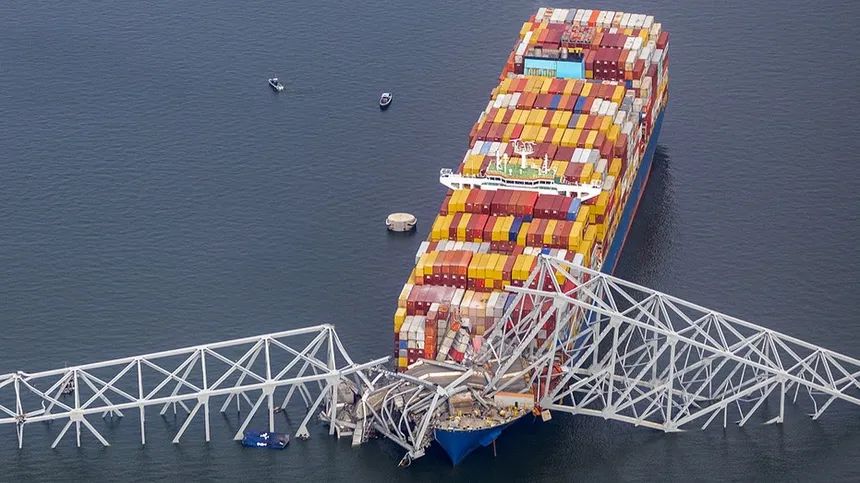
At 1:28 a.m. on March 26, 2024, the container ship Dali, which had lost power more than once in the minutes before, struck a pier of the Francis Scott Key Bridge, and the bridge came down into the Patapsco River. What followed for freight was a channel blocked by wreckage, temporary passages that opened in stages (about 15 percent of pre-collapse shipping by April 20), and a full reopening 11 weeks after the collapse. A port that handled a record 52.3 million tons in 2023 finished 2024 at 45.9 million, still its second best year on record, which sounds like a recovery and is, but it hides what happened to the shippers in the middle.
What this article cares about, though, is what happens mechanically inside a supply chain when a single gate that a lot of your freight passes through shuts without warning, and how much of the scramble that followed was a function of not knowing, ahead of time, where your cargo would go instead.
Three failures stacked behind one bridge
One gate, no mapped detour
Baltimore was a single point of entry for a lot of freight cargo, and when it closed, the cargo had to be discharged somewhere else. According to project44’s analysis, rerouted volume went mostly to New York (46 percent), then Norfolk (20 percent) and Newark-Elizabeth (9 percent). Nothing about those choices was irrational, but they were made in a hurry, by thousands of shippers at once, toward the same handful of ports. The detour existed on a map, but those ports charged considerably different fees in an event like this than the options shippers had planned around.
The cargo moved without the contracts
Here’s the part that turned a delay into a cost. project44 reports that containers sent to other ports sat longer than normal because trucking out of them hit bottlenecks on lanes that shippers had no contracts for, so many couldn’t find a carrier or a rate at all. Under force majeure, customers were responsible for arranging their own transport from the new discharge port. Meanwhile the clock on demurrage kept running: typical carrier contracts give three to five free days at the port, after which charges of $75 to $300 per day apply until the container is discharged. An estimate of the resulting bill therefore sits at roughly $85 million (to be clear, not an officially audited figure). A container is only as flexible as the weakest contract between the new port and the dock door.
A recovery that didn’t return everything
The channel reopened and the cargo largely came back, but not all of it went back to where it started. Baltimore handled 749,799 cars and light trucks in 2024 against a record 847,158 the year before, and the Port of Brunswick, Georgia, which FreightWaves reported benefited from diversions after the collapse, ranked first nationally in that category. Early in the disruption, General Motors said it was working to reroute vehicle shipments to other ports and Ford said it had already lined up alternatives where needed. Every day of delay is also a day that someone else’s port, someone else’s trucking network and someone else’s relationship gets a trial run with your freight.
“A container is only as flexible as the weakest contract between the new port and the dock door.”
Prevention: mapping the detour before the bridge comes down, not after it
The shippers who lost the least were, as far as the evidence suggests, the ones with the least to improvise: the ones with carriers and rates already in place on alternate lanes, visibility into which of their containers were headed to the affected port, and a clear idea of which of their freight and vendors depended on it. Knowing that a gate is a gate before it closes is a different thing from reading about it afterwards. This is directly where ScopeMatch steps in as a potential solution.
How ScopeMatch maps to each failure point
Six places where a company’s own records decide how exposed it actually is.
Vendor risk ratings & dashboard rollups
Every tracked vendor carries a location and a risk rating, and rolling that up across a vendor base turns “how many of our suppliers ship through the same port” into a visible number instead of a surprise. If a handful of vendors that look unrelated all route through one gateway, the rollup shows it before the news does. The system even allows for simulation of “what if these vendors in this specific geographical region all become unavailable.”
Workflow-based qualification
A backup supplier, carrier or logistics partner moves through a defined pipeline of stages, checklists and document requirements, rather than a cold start the week the port closes. Invitation links let a new partner begin submitting qualification documents the same day you identify them, which is how an alternate lane stops being a someday project and gets pre-qualified instead.
Document tracking with expiry alerts
Insurance certificates, carrier agreements, customs and compliance paperwork live on the vendor record with expiry alerts attached. A fast pivot to a carrier on an unfamiliar lane shouldn’t also mean discovering that their coverage lapsed last quarter.
Incidents with resolution records
A closure, a diverted container or a missed delivery becomes a logged incident with a type, severity, status and owner. After something like Baltimore you can see what was hit, when, how badly and who handled it, and you can see how much it cost, instead of each department remembering a different version of events.
Checklist notes with document evidence
When a partner confirms capacity on an alternate route, or says a diverted shipment will clear in a given window, that confirmation attaches to the checklist item with a note and any supporting document. It stops living in one person’s inbox, and it stops being an assumption everyone forgets to recheck.
Assignment, roles & comments
Every vendor and every incident has a named owner, with admin, manager, reviewer and viewer roles deciding who can act. When a gateway closes, comments on the affected vendor records notify the people who need to know right away, instead of whoever happens to see the news first.
The broader point
The Key Bridge collapse wasn’t a supply chain failure in origin. It was a ship, a loose connection and a pier, and nobody running procurement could have forecast that particular event. But the cost that landed on shippers (the detours, the unplanned trucking, the demurrage, some of the lost market share) came from how much of their freight was quietly tied to one port and how little had been arranged for the day it wasn’t available. Exposure you’ve mapped is a plan with a few blanks. Exposure you haven’t is a headline. ScopeMatch exists to make sure it’s the first one.
ScopeMatch — supply chain visibility for global manufacturing, distribution, and operations.