

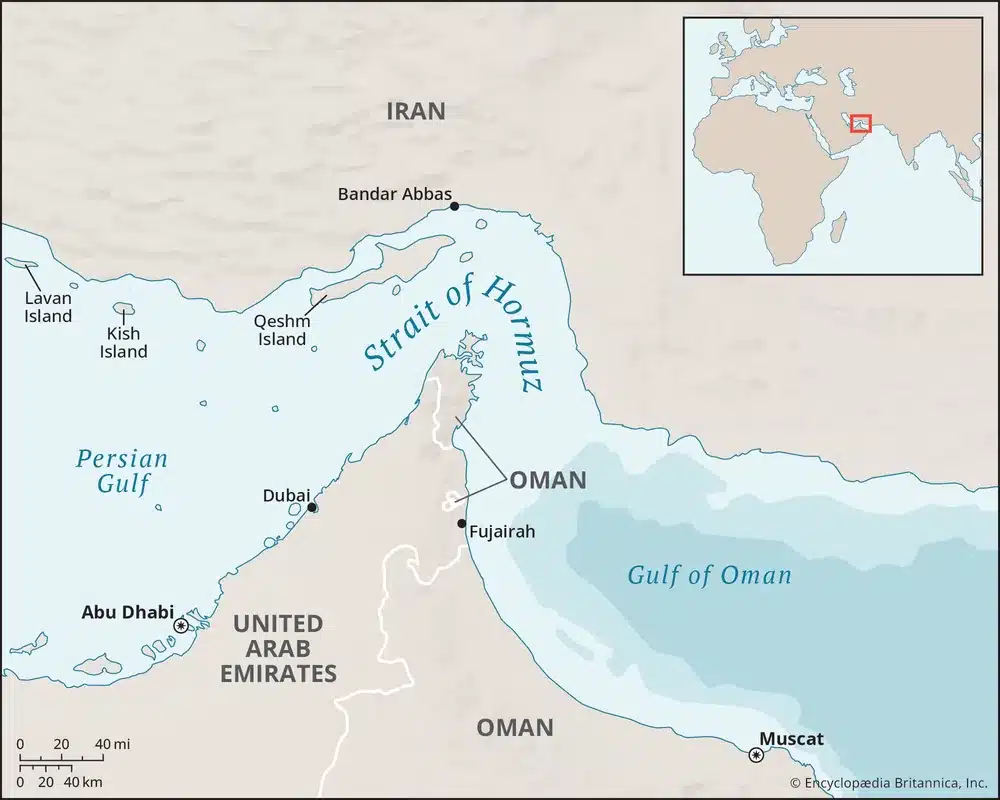
In late February 2026, a sharp military escalation in the Gulf region set off a chain of events that shut down, in practical terms, one of the most important 33 kilometers of water on the planet. Five months later, the Strait of Hormuz still hasn’t returned to normal. Ships are still being struck. A seafarer is still dead. And the global economy is still absorbing a shock that the International Energy Agency’s Fatih Birol has called the largest oil supply disruption in the market’s history.
This piece isn’t about the politics of how it started. It’s about what happens to a global supply chain when a single chokepoint, one that everyone in shipping and energy has known about for decades, actually closes. Who gets hit, how the damage spreads, and — because this is the problem we spend our days on — what it would have looked like to see this coming.
How a strait becomes a crisis
The Strait of Hormuz sits between Iran and the Arabian Peninsula, at its narrowest point about 33 kilometers of water separating the Persian Gulf from the Gulf of Oman and the open ocean beyond. It is, by a wide margin, the world’s most important oil chokepoint: roughly one-fifth of global oil and gas consumption moves through it, along with a substantial share of the world’s liquefied natural gas trade.
When the conflict broke out on February 28, Iranian forces responded by treating the strait itself as leverage. Within weeks, the Iranian Revolutionary Guard Corps had laid sea mines, issued warnings against transit, and begun boarding and striking merchant vessels attempting to pass. Commercial transits didn’t slow down — they collapsed, falling more than 90% from pre-crisis levels almost immediately.
The pattern has continued, not eased, in the months since. In the first two weeks of July alone, at least nine vessels came under attack as Iranian forces pushed ships toward routes through Iranian territorial waters rather than the corridor along Oman’s coast that the U.S. military has been protecting. One of those ships, the crude tanker Al Bahyah, was hit off the Omani coast — killing one crew member and injuring three more. It was a stark reminder that this isn’t an abstract commodities story. Real ships, with real crews, are sailing through an active conflict zone because the alternative is rerouting a fifth of the world’s energy trade around a continent.
“The largest supply disruption in the history of the global oil market.”
— Fatih Birol, Executive Director, International Energy Agency
Who actually gets hit — and it’s not just “oil prices go up”
The headline number is always the price of crude. But a chokepoint shock like this one ripples through the supply chain in layers, and most of those layers never make the evening news.
The direct importers
China, the world’s largest crude importer, sources roughly 40% of its oil through Hormuz. Japan sends about 70% of its Middle Eastern crude the same way. Neither country can simply reroute that volume — the alternative pipeline and shipping capacity to bypass the strait entirely doesn’t exist at this scale, at least not on short notice. Both have had to draw down strategic reserves, bid harder for non-Gulf crude, and absorb the price spread.
Every buyer of oil, everywhere
Modeling from the Dallas Fed put West Texas Intermediate at roughly $98 a barrel in the second quarter of 2026 under strait-constrained conditions, with a path to as high as $132 by year-end if the disruption continues at this intensity. The same modeling estimated the hit to global real GDP growth at close to 2.9 annualized percentage points for that quarter alone. That’s not a regional story — that’s a line item on budgets everywhere, from a trucking fleet’s fuel costs to a plastics manufacturer’s feedstock bill.
Chemical and methanol buyers, quietly
Oil gets the headlines, but roughly a third of global seaborne methanol trade also passes through Hormuz. China, the world’s largest methanol buyer, has seen port inventories edge toward warning thresholds as Middle Eastern exports stay curtailed. That’s a second-order shock — a chemical feedstock problem that started as a shipping-lane problem — and it doesn’t show up in a crude oil price chart at all.
Carriers, crews, and insurers
War-risk insurance premiums for the route have spiked, and some carriers have simply stopped offering it. Shipping companies are choosing between refusing the transit and paying dramatically more to run it. Crews are making that choice in person, as the Al Bahyah made clear.
Everyone two or three tiers away, who finds out last
This is the group that matters most for how we think about the problem. A refinery, a mine, or an industrial manufacturer rarely has direct visibility into which of its suppliers, or its suppliers’ suppliers, route critical inputs through a specific strait. That exposure sits two or three tiers back in the chain, invisible until a delivery is late, a price jumps without explanation, or a supplier goes quiet. By the time it’s visible, it’s already a fire to put out rather than a risk that was mapped and managed.
The uncomfortable part: this keeps happening
Hormuz is dramatic because of its scale, but the underlying failure mode isn’t new and isn’t unique to this one strait. Any supply chain that concentrates a critical input — a mineral, a component, a chemical feedstock — through one country, one supplier, or one shipping corridor is carrying the same kind of risk, just waiting for its own triggering event. Most organizations don’t find out how concentrated their exposure is until something forces the question. The Strait of Hormuz forced it for a lot of companies at once.
The question worth asking isn’t “could we have predicted this specific conflict.” Almost nobody predicts the specific trigger. The question is: did we know, going into February, exactly how much of our supply chain ran through this corridor, and what would break if it did? For most organizations, the honest answer was no.
Where ScopeMatch fits
Mapping exposure before it becomes a headline. We can’t forecast geopolitics, and we’re not going to pretend we can. What we do build is visibility into the thing that turns a regional event into a company-specific crisis: concentrated, unmapped exposure. Here’s what that looks like in practice.
Single-source & bottleneck detection
If a critical product in your network has exactly one vendor, or a cluster of vendors concentrated in one corridor, that’s flagged automatically — not discovered when the corridor closes.
Disruption simulation
Remove a country or a vendor from your network graph and see, before it happens, exactly which products go single-sourced or disconnected. This is the Hormuz scenario, run as a drill instead of a crisis.
Country-level exposure views
See what share of your vendor base, and which specific products, route through any given country or chokepoint — at a glance, not after a week of spreadsheet archaeology.
A real matching engine
Once exposure is identified, post the need and get ranked, scored alternative suppliers from across the network — a starting list within minutes, not a cold-call campaign.
Live inventory visibility
Digital Warehouse shows real stock at partner locations, so a buyer can check what’s actually available outside an affected corridor before committing to a new order.
An industry-tuned event feed
Ongoing monitoring surfaces supply-chain-relevant developments as they unfold, mapped against your own footprint rather than a generic news wire.
None of this stops a strait from closing. What it does is make sure that when one does, you’re the organization that already knows exactly what’s exposed and where to look next — not the one finding out from an invoice three weeks late.
Sources: Wikipedia, Al Jazeera, Axios, NPR, CNBC, the World Economic Forum, and the Federal Reserve Bank of Dallas. ScopeMatch — supply chain visibility for global manufacturing, distribution, and operations.