

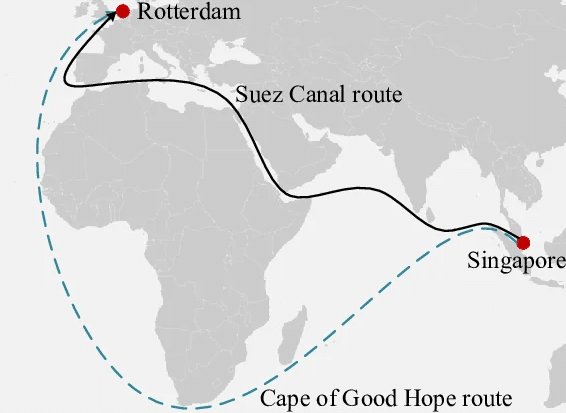
For most of 2025, the Red Sea crisis looked like it was finally resolving. Carriers were testing cautious returns to Suez, throughput was inching up, and procurement teams were starting to pencil the canal back into next year’s routing plans. Then, in late February 2026, renewed maritime attacks reversed it. Maersk, Hapag-Lloyd, and MSC all pulled back to the Cape of Good Hope route, and Suez Canal traffic has stayed subdued since.
This isn’t a piece about who’s attacking ships in the Red Sea. It’s about the fact that this is now the second time in three years a company’s freight budget got rewritten by a route that suddenly stopped being available — and about which companies had already built that possibility into their planning.
What actually happened to shipping and sourcing
The disruption compounded through three layers of the supply chain.
Transit time and capacity
The Cape of Good Hope detour adds 10 to 15 days to a typical Asia–Europe voyage — 14 days for northern Europe, 18 for southern Europe — and burns roughly 30% more fuel doing it. That extra sailing time also absorbs vessel capacity that would otherwise be available elsewhere, which is a large part of why rates didn’t just spike and settle back down; they’ve stayed structurally higher for two years running.
Freight rates and working capital
Asia–Europe rates stabilized 25 to 35% above pre-crisis levels after early spikes of 40 to 60%, with spot rates for a 40-foot container touching $10,000 during peak disruption windows. That’s not just a freight-budget problem. Longer transit times mean more inventory in transit at any given moment, which means more working capital tied up in stock that isn’t earning anything until it clears customs.
Retailers and manufacturers adapting in real time
The companies that adjusted fastest didn’t wait for the situation to stabilize before acting. IKEA got ahead of it by telling customers directly that some products would face longer lead times or limited availability — managing the disruption instead of absorbing it silently. Shein went further, shifting a significant share of its volume to air freight and opening near-shoring hubs in Turkey and Brazil specifically to serve EMEA and the Americas without touching the Red Sea at all.
Import-heavy sectors with less room to maneuver — pharmaceuticals, food processing, automotive components — absorbed the longer lead times and higher logistics costs directly into thinner margins, because rerouting an entire sourcing network on short notice isn’t an option every company has.
The dividing line wasn’t company size or industry. It was whether a company already knew, before the February 2026 escalation, exactly which of its inbound lanes ran through the Red Sea and how much margin it had to absorb a sudden 15-day delay.
Route exposure is a vendor question, not just a freight question
The standard advice hasn’t changed in two years — diversify origin ports, dual-source across regions that don’t share a chokepoint, renegotiate freight terms that assume Suez availability. What’s changed is how expensive it’s become to find out you needed that advice after the fact.
Route exposure isn’t really a shipping-desk problem in isolation. It’s a function of where your vendors sit. A company that knows, vendor by vendor, which suppliers ship through a given corridor can model a Cape-routing scenario in an afternoon. A company that only tracks that information informally finds out its exposure the same week the ships turn around.
Where ScopeMatch fits
Turning route exposure into a dashboard filter, not a scramble. Here’s how the platform lines up against each failure point above.
Vendor risk ratings & dashboard rollups
Every tracked vendor carries a location and a risk rating, rolled up across your whole vendor base. “How much of our inbound volume runs through the Red Sea” becomes a dashboard filter, not a call to every regional buyer to ask.
Workflow-based qualification
Standing up an alternate supplier outside a disrupted corridor runs through a defined pipeline — stages, checklists, document requirements — instead of an improvised scramble once a route stops being viable.
Document tracking with expiry alerts
War-risk insurance certificates, carrier agreements, and customs paperwork stay centralized per vendor with automated expiry alerts — so a fast reroute doesn’t also mean discovering a lapsed cover note mid-transit.
Incidents with resolution records
A delayed shipment or a rerouted lane becomes a logged incident — type, severity, status, owner — with the resolution on record, so the next disruption isn’t the first time anyone’s written down what happened last time.
Assignment & role-based access
Every vendor and incident can be assigned to a specific team member, with admin, manager, reviewer, and viewer roles controlling who can act. When a route closes overnight, “who’s handling this lane” isn’t a question anyone has to ask twice.
Comments with notifications
Comments on a vendor or inquiry notify the right people on both sides, so coordinating a reroute or a lead-time renegotiation happens in one place with a record attached, instead of scattering across carrier emails.
Suez has now been effectively unreliable for the better part of two years, through a cycle of tentative reopening and renewed closure that shows no sign of settling into something predictable. The companies that handled the February 2026 reversal calmly weren’t the ones who guessed right about when the canal would reopen — they were the ones who already knew exactly which vendors sat on that route and had a plan ready for the day it closed again. ScopeMatch exists to make that knowledge a standing dashboard, not a scramble every time the map changes.
Sources: GEP, Logfret, Marine Insight, Zencargo, One Union Solutions, Global Trade Magazine, GP Fulfillment, and the Bloomsbury Intelligence and Security Institute. ScopeMatch — supply chain visibility for global manufacturing, distribution, and operations.