

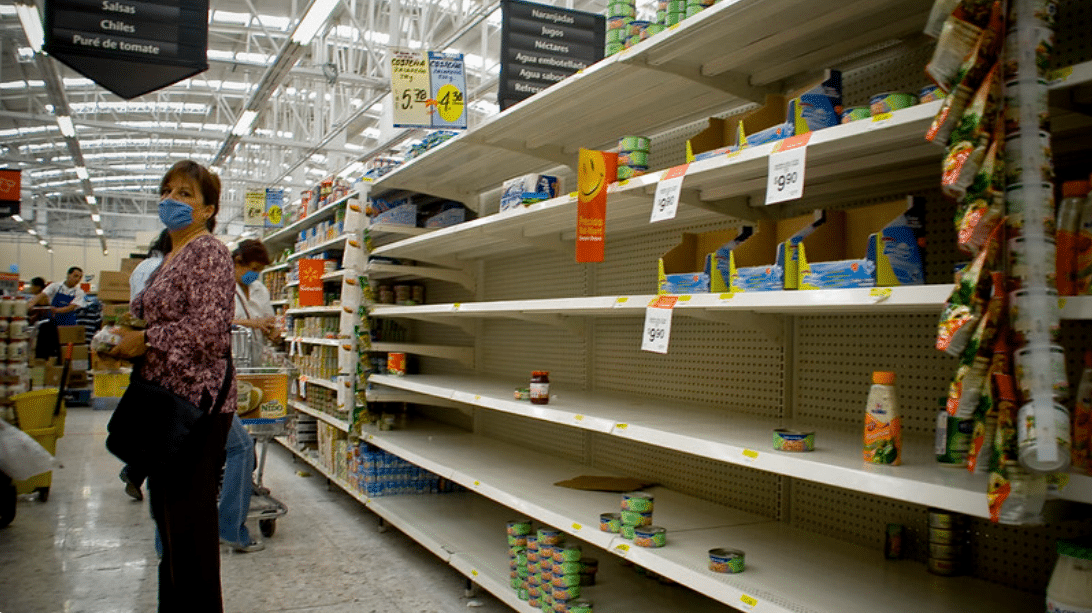
318 million people are living in crisis level hunger this year, and for the first time this century two
regions, Gaza and Sudan, are in confirmed famine at the same time. Fertilizer prices jumped 35 percent
in five months. None of it happened because the world stopped growing food. It happened because the
systems that move food from where it’s grown to where it’s needed kept breaking, one link at a time.
This isn’t a piece about who is to blame for a hungrier world. It’s about a specific, recurring
mechanism inside global food sourcing: a government somewhere decides to keep a harvest at home, and a
buyer somewhere else who was counting on that harvest finds out the same way everyone else does, from
a headline.
Three Layers of the Same Crunch
The Input Squeeze
Before food shortages show up as empty shelves, they show up as expensive fertilizer. Roughly a third
of the world’s fertilizer trade moves through the Strait of Hormuz, and conflict-driven disruption
there pushed urea prices up nearly 46 percent in a single month in early 2026, with broader fertilizer
costs running 35 percent above the prior year. A farmer who can’t afford fertilizer doesn’t produce a
smaller crop next season. In some cases, they don’t plant at all, and that shortfall doesn’t show up
in prices until the harvest that never happened would have arrived.
Food Nationalism
When a harvest comes in short, or even when a government worries it might, the fastest available lever
is to stop exporting. In 2022, 32 countries imposed 77 separate food export restrictions, concentrated
in wheat, feed grains, and vegetable oils. India banned wheat exports after a heatwave cut output, then
restricted broken rice exports the same year. Indonesia’s three week ban on palm oil exports affected
19 billion dollars of product and roughly 55 percent of the world’s palm oil calories, and prices
nearly doubled within months. Restrictions like these are individually rational, a government
protecting its own food supply first, and collectively costly: research on the 2007 to 2008 food price
crisis found export bans alone responsible for international rice prices running 40 percent higher
than they otherwise would have, 19 percent for wheat, and 10 percent for maize. A buyer with a
contract in hand has no recourse when the exporting government simply changes the rule.
Climate Sitting on Top of Both
Forecasters currently put the odds of an El Niño pattern emerging by mid-2026 at 61 to 87 percent. If
it materializes, rice output in affected growing regions could fall by 20 to 50 percent, landing on
top of a fertilizer market and an export policy environment that are already strained. None of these
three layers, input costs, export policy, and weather, moves on a predictable schedule. All three can
move in the same direction at once, which is largely what happened in 2026.
The part that’s actually addressable. Nobody sourcing food or agricultural inputs
controls weather, and few control fertilizer geopolitics. What a buyer can control is whether they
already know, before an export ban lands, which of their suppliers sit in a country with a history of
restricting exports under pressure, and whether an alternate source exists anywhere else in their
network.
Prevention: Treat Export Policy as a Tracked Risk, Not a Surprise
A shipping delay gives some warning. An export ban usually doesn’t, it can take effect the day it’s
announced. The companies least exposed to the next one aren’t the ones with the best government
relationships. They’re the ones who already have a documented, current picture of where each
ingredient or input actually originates, and who have at least started the qualification process on a
second source before they need it.
How ScopeMatch Maps to Each Failure Point
Six places where a documented picture of the supply base, not luck, determined who kept shipping.
Vendor risk ratings and dashboard rollups
Every tracked vendor carries a location and a risk rating on record. Rolling that up shows
exactly how much of a company’s ingredient or input supply sits in a country with a recent
history of export restrictions, before the next one is announced.
Workflow based qualification
Standing up an alternate supplier in a different growing region runs through a defined pipeline,
stages, checklists, document requirements, instead of a cold start the week the primary source
stops shipping. Invitation links let a new supplier begin submitting qualification documents the
same day you find them.
Document tracking with expiry alerts
Phytosanitary certificates, origin documentation, and supply contracts are centralized per
vendor with automated expiry alerts, so a fast pivot to a new supplier doesn’t also mean
discovering missing paperwork at customs.
Checklist notes with document evidence
When a supplier confirms they can still fulfill an order despite tightening conditions, that
confirmation attaches directly to the relevant checklist item with a note and any supporting
document, on record instead of living only in a phone call.
Incidents with resolution records
A cancelled shipment or a price spike tied to an export restriction becomes a logged incident,
type, severity, status, owner, rather than a loss nobody can reconstruct when renegotiating that
contract later.
Assignment, roles, and comments
Every vendor has a named owner, with admin, manager, reviewer, and viewer roles controlling who
can act. When a restriction hits overnight, comments on the affected vendor records notify the
right people immediately instead of scattering across separate inboxes.
The Broader Point
Food export restrictions are, individually, defensible decisions by governments protecting their own
populations. Collectively, they’re a recurring and largely predictable pattern: when conditions
tighten, exporting countries tend to look inward first. A buyer who has already mapped where every
input actually comes from isn’t betting on any government’s restraint. ScopeMatch exists to make that
map already exist, before the next ban does.
Sources: World Bank, World Bank Blogs, EBC Financial Group, Food Ingredients First, IFPRI, Bruegel, and Gulf News. ScopeMatch — supply chain visibility for global manufacturing, distribution, and operations.